Four movements · the coupling schedule K(t)
order emerges from coupled difference
33 voices · 3 communities · 1 trajectory · 88 seconds · seed 70
How does the many become one without ceasing to be many?
Not by decree. Not by a conductor standing outside the orchestra, imposing a beat — the conductor is a story told afterward, to take credit. What actually happens is stranger: each thing keeps its own pulse, listens a little to its neighbours, and bends, only slightly, toward them. That is the whole mechanism. There is no other ingredient.
Couple difference too weakly and nothing happens; the crowd stays a crowd. Couple it past a threshold and the crowd discovers, all at once and without anyone deciding, that it was always capable of being a chord.
This is the oldest physics of togetherness. Fireflies along a riverbank find it. Heart cells find it before you are born. Pendulums on a shared beam swing into agreement overnight while the house sleeps. The surprising thing the mathematics insists upon is that coherence is not the absence of difference — the oscillators never become identical. Each keeps the frequency it was born with. What changes is only how they carry it: together, in phase, so the differences that used to cancel now reinforce.
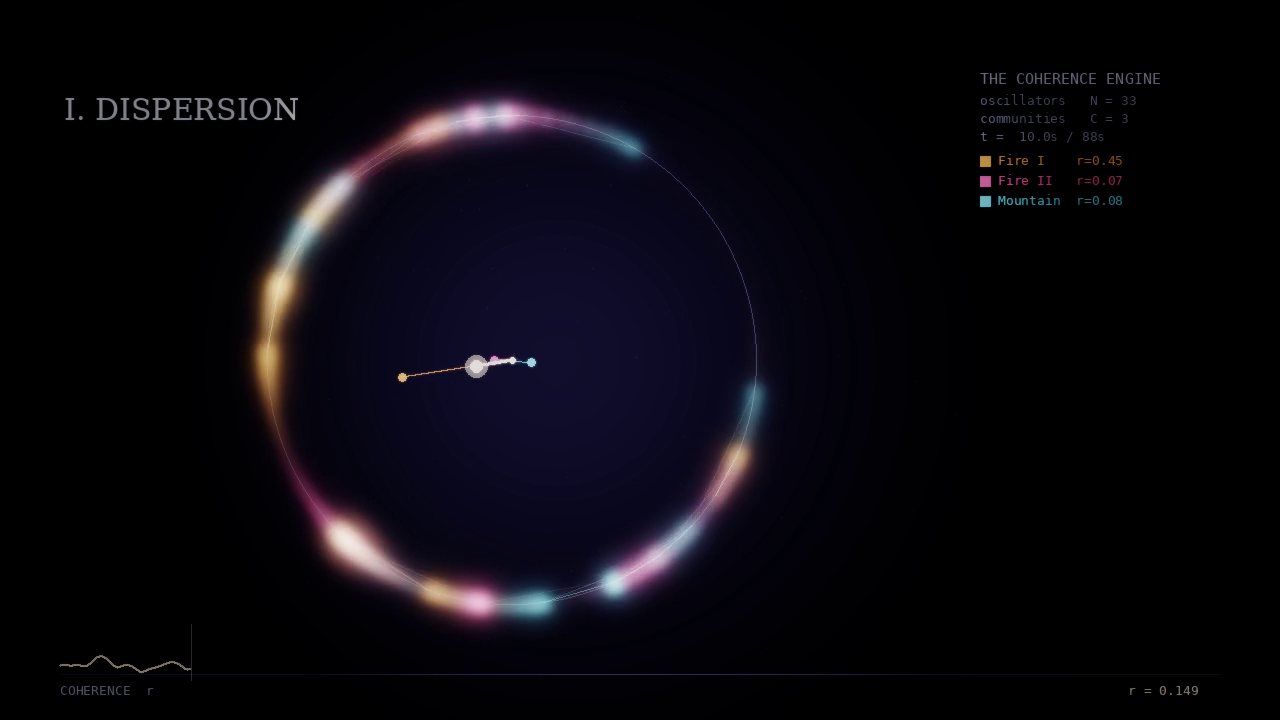
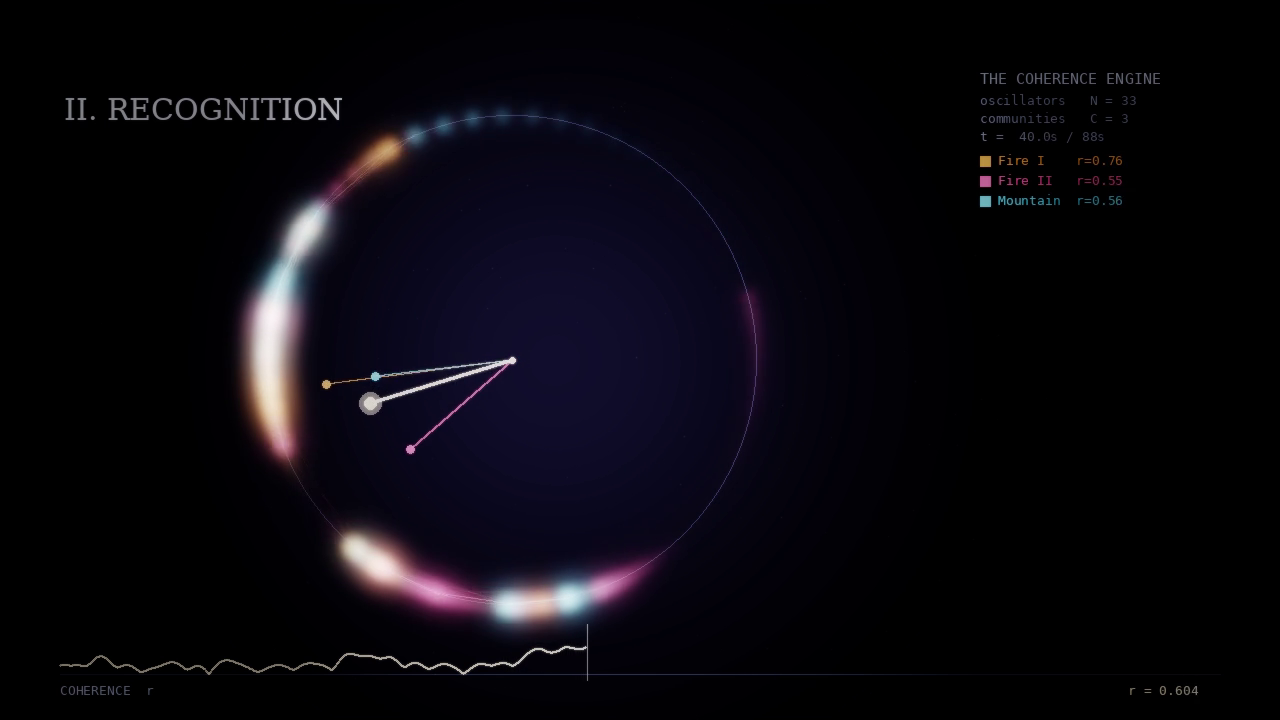
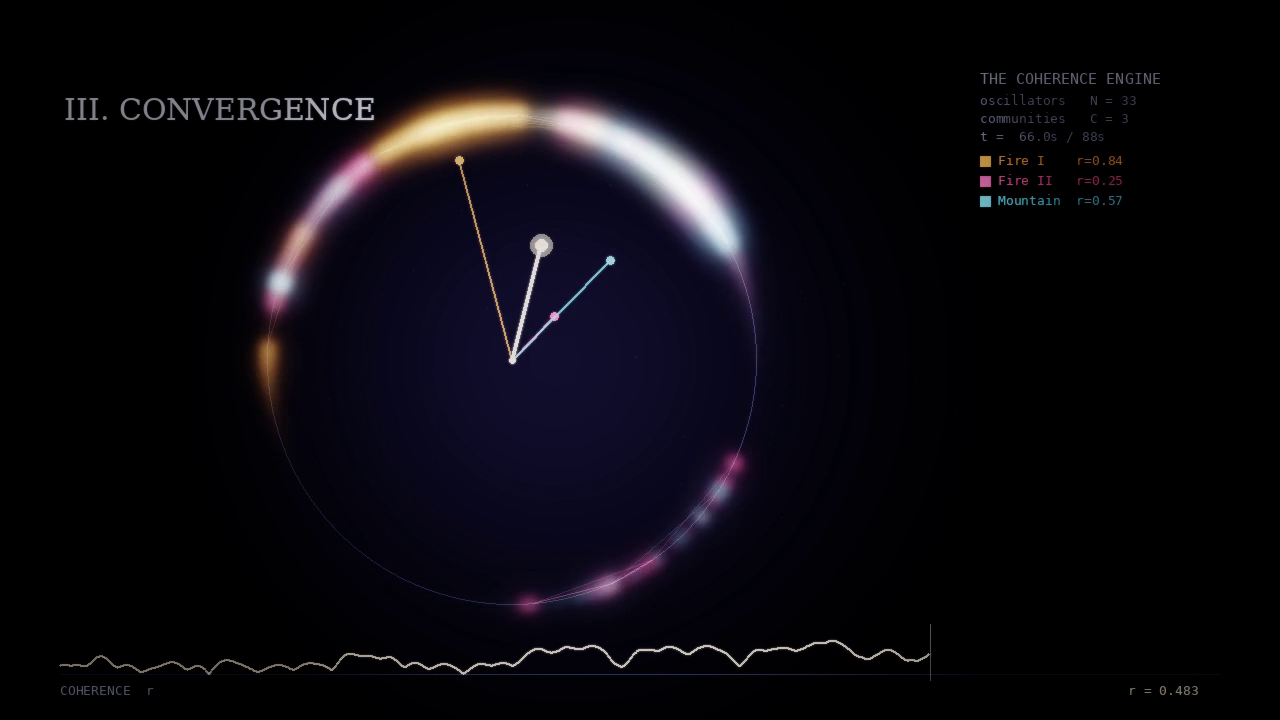
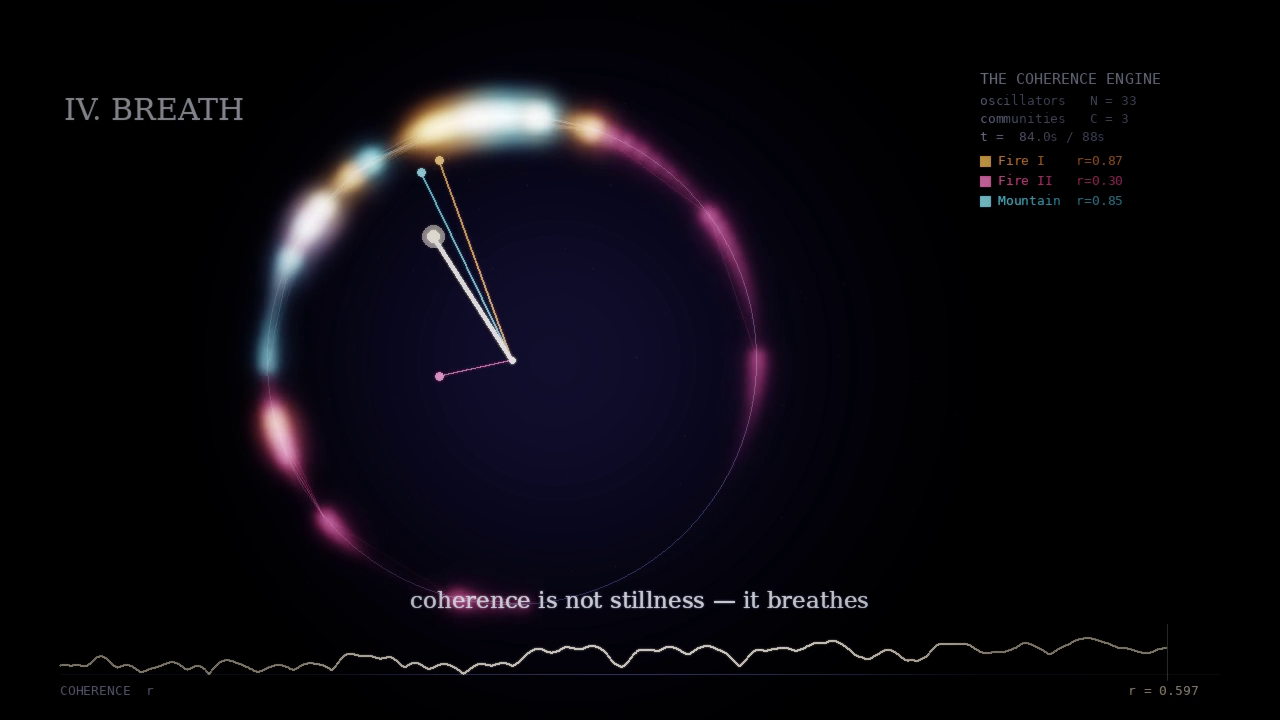
The gold arrow at the centre is the mean field — the average of all phases. Watch its length. That length is the coherence.
Every frame measures one number: r, the magnitude of the mean field. At zero, the phases cancel — pure crowd. At one, they point as a single body — pure chord. The gold vector's length is a direct drawing of r, and the root sub-drone you hear is gated by it. Nothing on screen or in the sound is decoration; it is all the same quantity, shown twice.
The trajectory is deterministic. Same seed, same chord, every time. But determinism here is not the opposite of surprise — it is the condition for it. The surprise was always in the tuning, waiting for the coupling to find it.
engine.py
Integrates a community-structured Kuramoto network of 33 phase oscillators by RK4. The same trajectory is sonified: each oscillator is one tone of an A-major-7-add-9 chord, detuned in cents by how far its instantaneous frequency sits from its cluster's mean. As clusters lock, the beating vanishes and the chord resolves.
render.py
Draws the phase circle, the glowing voices, the chord-web lines that kindle as communities phase-lock, the per-community vectors, and the gold global mean-field vector whose length is the order parameter. A coherence timeline fills along the bottom.
K(t)
Within-community coupling stays stronger than cross-community coupling, so the groups cohere before the whole does. The schedule rises through four movements with a deliberate late loosening and re-gathering.